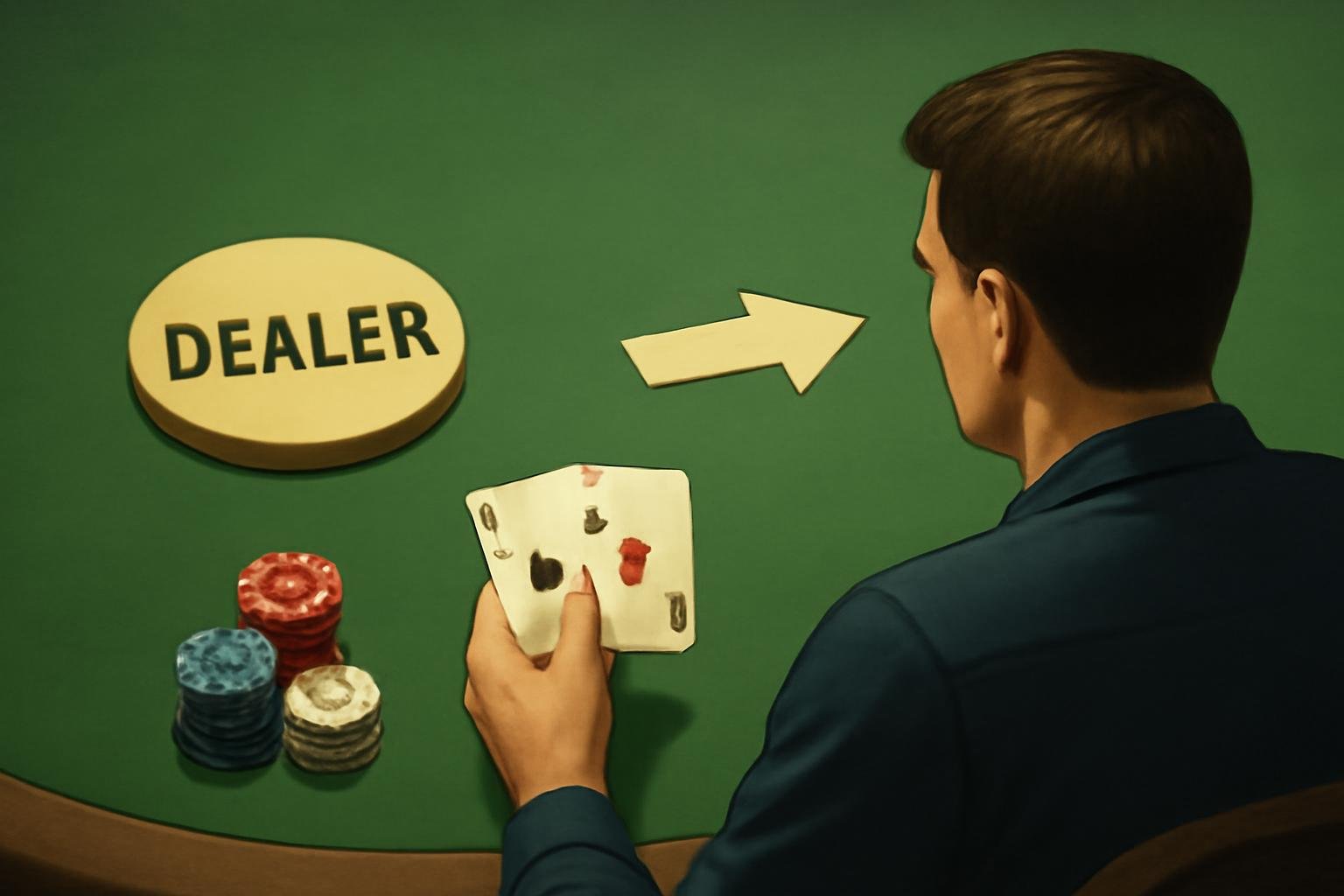
You’re holding a decent hand, but three players still have to act after you. The same cards would feel much easier to play if everyone had already checked. That difference is poker position: where you act in the betting order, and how much information you get before making a choice.
Position doesn’t make a hand automatically strong or weak. It changes how clearly you can judge the action, which affects whether calling, raising or folding makes sense. Here’s how to use that information at a poker table.
What “position” means
In games such as Texas Hold’em, players act in a set order. The dealer button marks the nominal dealer, and the blinds act early before the flop. After the flop, the first active player to the left of the button usually acts first, and the button acts last.
Players who act earlier are said to be “out of position” against players who act later. A player who acts later is “in position.” The button is often the most advantageous seat after the flop because its player can see what opponents do before choosing an action.
That extra information is useful, but it isn’t a guarantee. An opponent may still have a stronger hand, and a late position can’t rescue a poor decision.
Why acting later can help
Imagine you hold a marginal pair after the flop. If you act first and several opponents are still to respond, you have to choose without knowing whether they’ll check, bet or raise. If you act last and the others check, you can often make a more informed choice about checking behind or betting.
Acting later also gives you a chance to respond to the size and pattern of bets. A small bet and a large bet don’t communicate the same thing, though neither one reveals an opponent’s cards with certainty. Position helps you weigh the available clues; it doesn’t turn those clues into proof.
Adjusting your decisions by seat
From an early seat
With several players yet to act, be careful about entering a pot with hands that are difficult to play after the flop. If someone behind you raises, you may have to make another decision with limited information. Stronger, more straightforward hands are generally easier to manage here than speculative hands that rely on favourable community cards.
Before acting, ask yourself: “If I call and someone behind me raises, what will I do?” If you don’t have a sensible answer, folding may be simpler than hoping the problem goes away.
From a late seat
When you’re near the button, you’ll often know how the players before you have acted. If everyone folds to you, the situation differs from one where several players have called. A raise may be worth considering when the action is unopposed, but the players in the blinds still get a chance to respond.
Don’t treat late position as permission to play every hand. A weak hand can still be dominated, and a call can create a difficult pot if you miss the flop. Consider your cards, the players already involved, the size of the raise and how comfortably you can continue on later streets.
A quick position check before you act
- Who acts after me? More players left to act means more chances someone raises or calls.
- What has happened so far? A raise, a call and a round of folds are different situations.
- What’s my plan after the flop? Think ahead rather than choosing a hand only because it looks playable now.
- Can I afford this decision? Keep to a limit you set before playing; don’t chase losses or increase stakes to recover them.
Common position mistakes
One mistake is memorising a list of hands without considering the action. A hand that might be playable when everyone folds to you may be a poor choice after a raise and several calls. The situation matters as much as the cards.
Another is assuming a late-position bet will always make opponents fold. Someone may call or raise, so decide in advance what you’ll do if that happens. And when you’re first to act, avoid betting just because you feel exposed. Choose an action based on the hand, the board and the likely responses, not discomfort alone.
If you’re learning the rules, a beginner’s poker guide can help you get comfortable with the basic flow of a hand. Position is also part of the decision-making process behind poker’s mental game; staying patient matters when your seat gives you less information. For a broader skills refresher, see core poker skills.
Put position into practice
In a free or low-pressure practice session, note your seat and the action before each decision. You don’t need a complicated chart. Simply compare what you chose from an early seat with what you chose when acting later, then ask whether the number of players left to act changed your plan.
Before your next hand, take a beat to identify who acts after you. That small habit can stop you from treating the same cards as the same decision in every seat.